Genomic data marketplaces
Token-incentivised genomic data marketplaces have a long history of bold framing and short history of operation. This note walks through the recurring design questions and the cautions that follow.
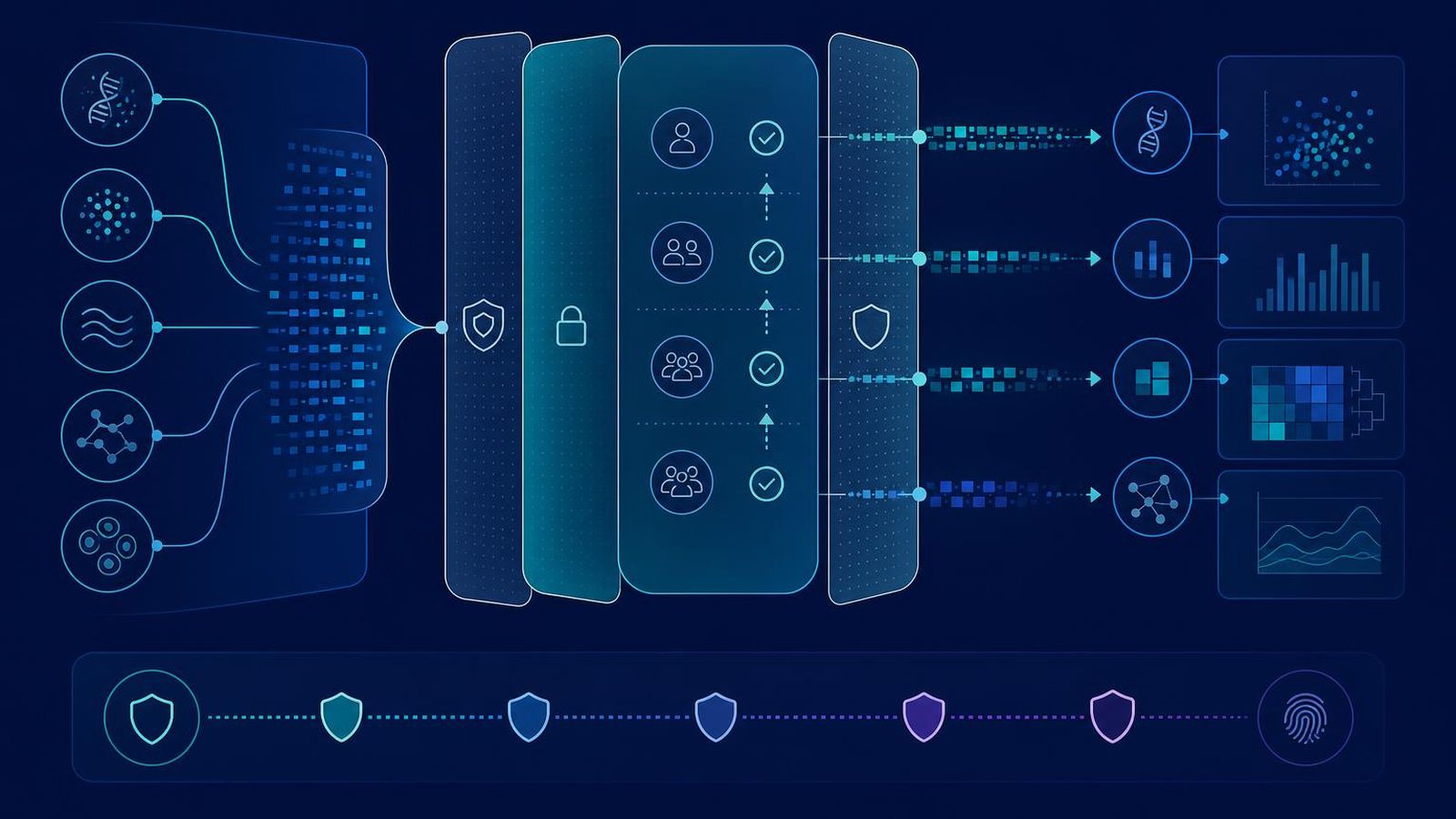
Genomic data marketplaces are a recurring proposal in the biomedical blockchain space. The pitch usually combines three claims: that individuals own their genomic data, that ledger-based marketplaces let them monetise it, and that token incentives align researchers and contributors. Each claim survives some scrutiny and not others. The interesting work in this corner of the field is in projects that engage with the harder parts of the picture rather than the slogan version.
What genomic data is
Genomic data is a distinct category of biomedical data for a few reasons. It is, in most respects, immutable for the individual. It carries information about relatives who never consented to anything. It is increasingly easy to re-identify even when stripped of conventional identifiers. It interacts with insurance, employment, and family relationships in ways that ordinary clinical data does not. Those properties shape what a marketplace can sensibly do with it.
Specifically, deletion does not really work as a privacy primitive. If a copy has been released, even in summary form, the information can persist indefinitely. Consent has to be considered with that property in mind. So does revocation, which can be honoured for future access but not retroactively unwound.
Consent is heavier here
Consent in the genomic marketplace setting carries more weight than in most other biomedical data contexts. The participant is consenting to use that will continue past the point where they can meaningfully change their mind. They may be consenting on behalf of relatives who have no role in the decision. They may be consenting to combinations of data that did not exist when they consented. The consent design has to engage with that or it does not deserve to be called consent at all.
The credible projects in this space treat consent as a structured, revocable, scoped artefact rather than a one-time signature. They tier the access carefully: aggregate statistics, summary results, derived signals, and individual-level data sit on separate access tiers with separate consent. They make revocation real for the tiers where it can be honoured and are honest about the tiers where it cannot.
Re-identification is the silent risk
The biggest practical risk in genomic marketplaces is re-identification. A small number of well-chosen variants can identify an individual against public reference datasets. Combining genomic data with phenotypic data, or with metadata about when and where a sample was collected, accelerates the problem. The marketplace's privacy model has to engage with this directly, not treat it as a research curiosity.
The available mitigations include differential privacy techniques on aggregate queries, tiered access with strong vetting at the individual-data tier, query auditing, and contractual obligations that travel with released datasets. None of those primitives is perfect, and each carries trade-offs that have to be made deliberately. A marketplace whose privacy story is "the data is anonymised" has not engaged with the problem.
Token incentives carry baggage
The token incentive layer in genomic marketplace pitches deserves particular caution. The premise is that participants are paid in tokens for contributing data, and that researchers pay tokens for access. The premise is not absurd, but it carries baggage. Token prices fluctuate. Speculative dynamics can dominate the actual exchange dynamics. Regulatory treatment of the tokens themselves can vary by jurisdiction. The incentive that gets contributors to share data may not be aligned with the incentive that gets researchers to use it well.
The honest version of the token argument is that the token is a unit of account inside the marketplace, not a vehicle for wealth creation. Marketplaces that have made progress tend to play down the speculative angle and play up the utility angle. Marketplaces that have leaned into the speculative angle have tended to attract regulators rather than participants.
Marketplace governance
A genomic data marketplace is, among other things, a governance system. Someone decides what data is admitted, who can request access, what scopes are permissible, how disputes are handled, and how the rules change over time. The ledger can record those decisions. It cannot make them.
The credible projects publish their governance arrangements with the same care they publish their technical architecture. They name the parties involved. They describe the dispute resolution paths. They are clear about how rule changes propagate. They engage with the role of institutional review and oversight rather than presenting the marketplace as a substitute for it.
What the directory looks for
The directory's posture for genomic marketplace projects is conservative. The combination of irreversible privacy properties, complex consent obligations, and token incentive dynamics produces a high failure rate. Inclusion is not endorsement, and confidence labels are weighted accordingly. Projects that engage substantively with consent, re-identification, and governance are categorised differently from projects that gloss over those questions.
The site does not assess the commercial viability or scientific value of any particular marketplace. It does describe the shape of the design space and the questions that recur. The intent is to give readers a structured frame for evaluating new proposals, not a verdict on existing ones.
Related notes
For the privacy and consent picture this note depends on, see privacy and consent. For the identity infrastructure that participant onboarding has to use, see decentralised identity. For the patient-held framing in more detail, see patient-controlled records. The genomics use case page summarises the directory's approach in shorter form.